
A battery-powered aircraft’s first flight does not establish whether it can carry a useful load, keep its timetable in difficult weather and earn enough to pay for the aircraft, batteries, crew and airport infrastructure. Electric aviation’s future depends on demonstrating those capabilities in regular operations.
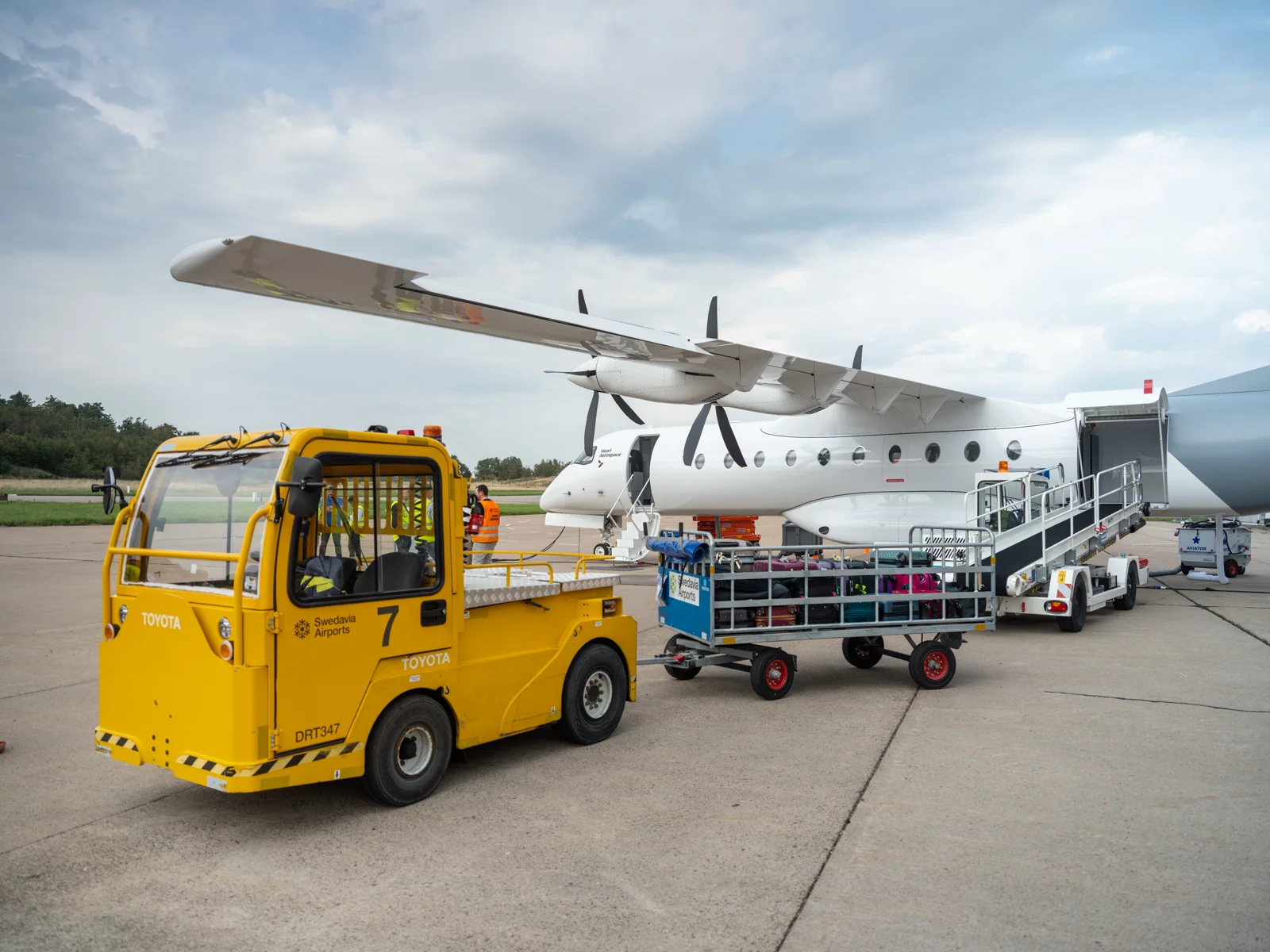
Heart Aerospace’s X1 provides a useful starting point. The Los Angeles-based company reports that its battery-electric demonstrator made its first flight on 12 August 2026 at Plattsburgh International Airport in New York. The piloted mission lasted 27 minutes and reached 1,100 feet above ground. It operated under an FAA experimental airworthiness certificate, rather than an approval for routine airline service. [1].
This was an important demonstration at regional-aircraft scale. It did not establish the range, payload, reliability or operating economics of a certified passenger aircraft. Nor does it mean that every aircraft emerging from the programme will run exclusively on batteries. The distinction between an experimental flight and a working transport system is essential to understanding what comes next.
There has already been a significant design change. In September, Heart announced the 36-seat ES-36 as its intended production aircraft, superseding the ES-30. Its published targets are 200 kilometres of battery-only range, plus reserves, and 1,200 kilometres in hybrid operation, plus reserves. The latter uses fuel-burning turbogenerators to supply electricity. These are development goals, not ranges demonstrated by X1’s August flight. [2].
The attraction is clear. Electric motors can convert electrical energy into useful propulsion efficiently, and aircraft designers can distribute them in ways that improve an aircraft’s overall performance. Battery-only flight also removes combustion exhaust from the aircraft during operation. For short journeys where fuel and engine maintenance are substantial costs, that combination could support cleaner, quieter and potentially cheaper services. NASA distinguishes these all-electric systems from hybrids that retain fuel-powered machinery. [3].
But a battery-powered aeroplane faces a tougher weight problem than an electric car. Every additional kilogram must be lifted and carried throughout the flight. More batteries can extend endurance, yet their weight increases the energy required and can displace passengers or freight. Unlike fuel, a battery does not become substantially lighter as its stored energy is used. Better motors help, but they cannot eliminate the storage problem.
The relevant measure is useful energy per kilogram of the complete installed system, not an impressive laboratory cell alone. Cooling, containment, wiring and protective margins add weight. Take-off also demands high power, while the equipment must manage heat safely. NASA identifies weight and heat as central obstacles to scaling electrified propulsion into larger aircraft. [4].
Range therefore needs careful reading. An aircraft cannot plan to arrive with its batteries exhausted. It needs an approved allowance for operational contingencies, which can include holding, a missed approach or diversion. Headwinds, temperature, payload and battery condition also affect usable performance. There is no single reserve percentage that readers can safely apply to every design and operation. The commercially useful question is which routes the aircraft can serve repeatedly, with passengers, baggage and the required margins.
Near-term opportunities are consequently likely to be selective. Training flights return to the same airfield and can have predictable durations. Short cargo routes and island connections may offer valuable time savings where surface alternatives are slow. In Europe, EASA certified Slovenia’s two-seat Pipistrel Velis Electro in 2020, primarily for pilot training: electric aircraft are already more than an experimental idea, although that small-aircraft achievement cannot establish the readiness of a regional airliner. [5].
Globally, the strongest routes will depend on geography. A short crossing between islands can save hours compared with a ferry. A similar-distance flight between cities connected by frequent electric trains may add little once airport access and boarding are counted. Remote communities could gain more reliable connections, but thin demand, harsh weather and expensive infrastructure can also make precisely those services difficult to sustain.
Airports form another part of the aircraft system. Charging needs electrical connections, equipment, parking procedures and trained staff. BETA’s airport Charge Cube, for example, is rated at 320 kilowatts and includes a separate thermal-management arrangement. That illustrates the scale of the ground equipment involved; it is not a specification for charging Heart’s aircraft. [6].
A charger’s maximum rating is not a promise that every aircraft can turn round at that rate. Battery temperature and charging limits matter. Several aircraft arriving together can create concentrated demand, potentially requiring network upgrades or local storage. An operator must also consider a failed charger, a delayed inbound aircraft and charging facilities at a diversion airport. A cheap unit of electricity is only one component of dependable service.
Certification is another substantial undertaking. The FAA’s published process separates approval of an aircraft’s design from approval of its production system, with compliance evidence, conformity checks and flight testing along the way. A successful prototype flight answers some engineering questions; it does not complete those steps. International expansion also requires the relevant approvals in destination markets, rather than assuming a US milestone automatically authorises operations elsewhere. [7].
Battery safety deserves particular attention without treating it as an argument against the technology. High-energy electrical systems introduce hazards that designers must control, including overheating and the effects of a failed cell. The FAA has established guidance on rechargeable lithium-battery installations and their continued airworthiness. The practical test is whether an integrated aircraft can manage failures safely, including after years of maintenance and daily use. [8].
Environmental claims need equally clear boundaries. No combustion exhaust during battery-only flight does not mean a journey has no environmental footprint. Electricity generation, aircraft and battery manufacture, battery replacement and eventual disposal all matter. Cleaner electricity and a well-used aircraft improve the case; lightly occupied services and frequent battery replacements weaken it. The comparison should measure a complete journey against the realistic alternative, rather than just the propulsion system.
Electric aircraft may also be quieter, but they will not be silent. Propellers and airflow still create sound, and frequency of flights matters to neighbours. EASA’s environmental work reports noise advantages for small electric aircraft while developing assessment methods for newer designs. Those results should encourage measurement, rather than an assumption that every larger aircraft will produce the same benefit. [9].
For long-haul travel, a successful regional demonstrator does not remove the battery constraint. More efficient airframes, operations and lower-emissions fuels remain important alongside electrification. Hydrogen-based fuels are another possible contribution, but production costs and supply infrastructure remain obstacles; the IEA’s 2026 review finds that low-emissions hydrogen and its derivatives are not ready at scale to relieve immediate energy-market pressures. These approaches may coexist and compete, with their economics depending on aircraft size and route. [10].
The commercial verdict will come from complete accounts: acquisition and financing, battery replacement, maintenance, staff, insurance, infrastructure and the share of seats sold. Lower energy costs do not automatically produce lower fares, and an aircraft order does not demonstrate profitable service. Watch certified performance with useful payload, dispatch reliability, battery life, measured noise and cost per occupied seat. Electric aviation could transform particular journeys well before it transforms the whole industry. Proving those journeys work would be a substantial achievement.
Sources
The links below support the statements attributed to them. A source’s own claims are identified in the article.
- Heart’s flight announcementHeart Aerospace · Primary source; manufacturer results and targets attributed in the article
- Heart’s September updateHeart Aerospace · Primary source; manufacturer results and targets attributed in the article
- NASA’s propulsion overviewNASA · Primary official source
- NASA’s electric-flight questions and answersNASA · Primary official source
- EASA’s certification announcementEASA · Primary official source
- BETA’s charger specificationsBETA Technologies · Primary source; manufacturer results and targets attributed in the article
- FAA’s certification processFederal Aviation Administration · Primary official source
- FAA battery-installation guidanceFederal Aviation Administration · Primary official source
- EASA’s electric-propulsion assessmentEASA · Primary official source
- IEA’s 2026 hydrogen reviewInternational Energy Agency · Primary official source