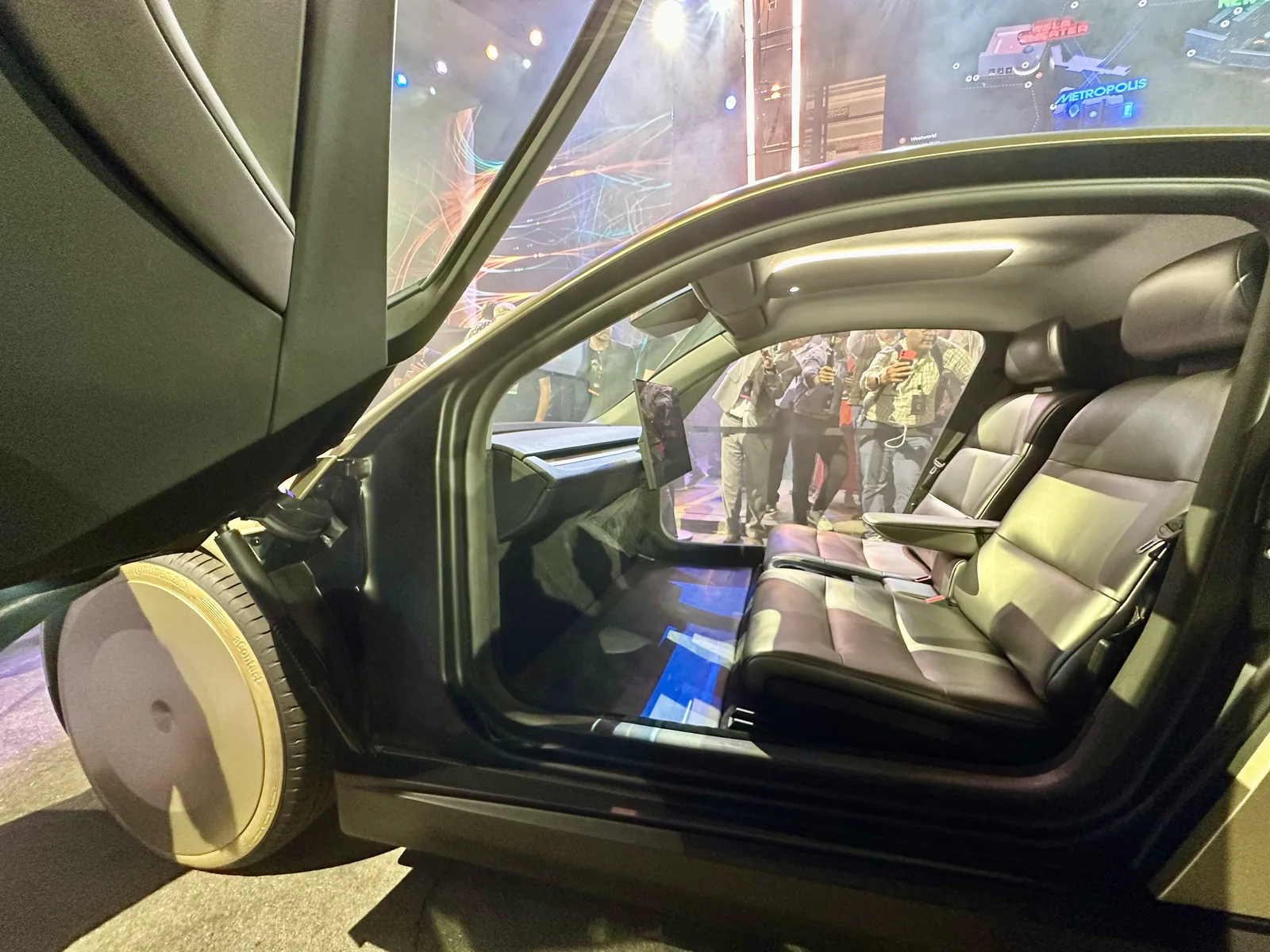

Tesla’s latest Robotaxi Safety Report covers about 3.1 million miles from 22 January to 18 October 2026, driven without a safety monitor inside. Its definition includes remote assistance and remote control. The live mileage counter estimates further travel beyond that safety snapshot. [1]
Tesla reports zero injuries under its first-contact definition, zero deployments of its own airbags and zero first-contact pedestrian or cyclist collisions. Its linked spreadsheet contains 32 incident records, including remote-control contacts and a pothole injury allegation Tesla says its investigation did not substantiate. These are company-reported results. [1,2]
Tesla-reported safety snapshot
Three reported zeros
22 January–18 October 2026
About 3.1 million miles with no onboard safety monitor; remote assistance and control included.
- 0People injuredPeople injured in collisions where Robotaxi made first contact.
- 0Robotaxi airbags deployedDeployments of the Robotaxi vehicle’s own airbags.
- 0Pedestrian or cyclist first contactsCollisions with a pedestrian or cyclist where Robotaxi made first contact.
These measures do not count all collisions. Tesla’s linked file lists 32 incident records; they are not an independently reconciled total of physical collisions.
Tesla: Robotaxi Safety Report · Tesla: Robotaxi SGO incident extract, cutoff 18 October 2026
The human comparison has a limitation: Tesla estimates 9.1 injury collisions for human vehicles over 2.95 million Texas miles, but counts human involvement regardless of first contact. Its own injury measure is narrower. These outcomes do not support a straight safety multiple. The separate FSD (Supervised) system requires a human driver’s attention; its mileage cannot be pooled with driverless operation. [1,3]
Definitions matter
What Tesla reports and what it models
22 January–18 October 2026
| Measure | Tesla’s reported result | Tesla’s modelled human comparison |
|---|---|---|
| Injury measure | 0 people injuredPeople in Robotaxi-first-contact collisions; full fleet. | 9.1 injury collisions estimatedAll human-vehicle involvement, regardless of first contact. |
| Airbag measure | 0 own-airbag deploymentsRobotaxi’s own airbags; full fleet. | 4.1 collisions with own-airbag deployment estimatedHuman vehicle’s own airbags. |
Reported zeros: about 3.1 million fleet miles. Human estimates: 2.95 million miles on surface streets in Austin, Dallas and Houston.
These are different endpoints and exposure sets, not directly comparable risk rates. The figures cannot establish a safety multiple.
The wider question reaches beyond Tesla. A system could substantially reduce road deaths and still be involved in a fatal collision. Public confidence depends on understanding both the reduction and the failure. Treating any death as proof that automation cannot work would set a standard human driving could never meet. Treating an improved average as permission to dismiss individual deaths would leave preventable failures unexamined.
The concern is that a demand for better safety might become a demand for certainty: a 100% guarantee that a new technology will never cause harm. This is a question to examine. The evidence considered here does not establish that society is becoming more risk-averse over time.
Human driving carries a large, continuing cost. The US National Highway Traffic Safety Administration estimated 36,640 road deaths in 2025, around 100 a day. Its full-year estimated rate was 1.10 deaths per 100 million vehicle miles. That is the existing risk against which a genuinely safer alternative would have to be assessed. [4]
Fatalities are also rare enough, relative to total travel, to make early evidence difficult to interpret. At that national rate, a hypothetical fleet covering 3.1 million miles would correspond to about 0.034 expected road deaths. This arithmetic illustrates scale; it is not an estimate of Tesla’s risk. Different routes, vehicles and operating conditions prevent that simple comparison. A small fleet could record no deaths without having demonstrated a lower fatality rate.
Fixed mileage snapshot
Where Tesla reported driving
22 January–18 October 2026
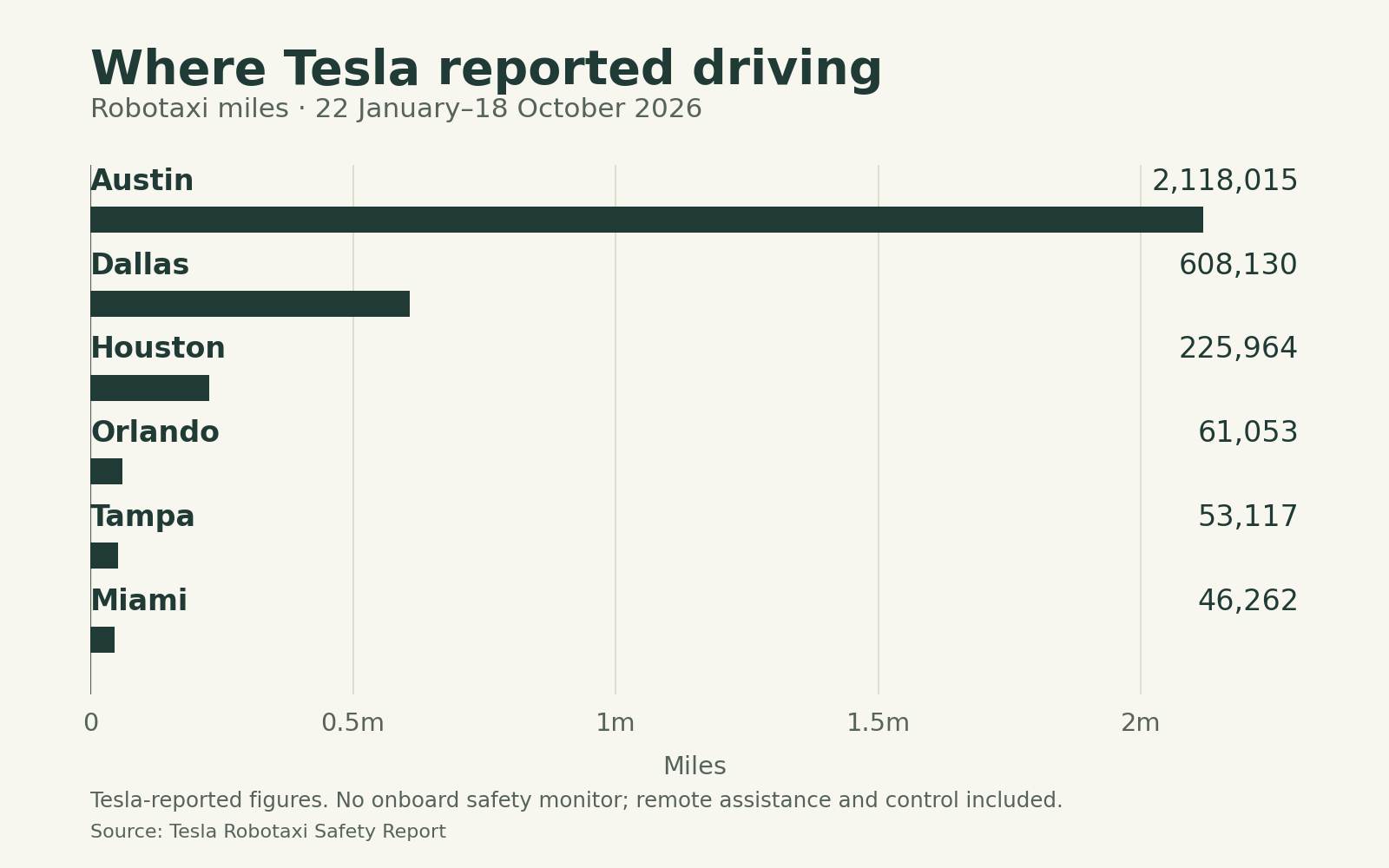
| City | Reported miles |
|---|---|
| Austin, TX | 2,118,015 |
| Dallas, TX | 608,130 |
| Houston, TX | 225,964 |
| Orlando, FL | 61,053 |
| Tampa, FL | 53,117 |
| Miami, FL | 46,262 |
| Sum of reported cities | 3,112,541Calculated from the six city figures. |
Open the standalone chart (PNG)
No onboard safety monitor; includes remote assistance and control.
Calculated sum of the six city figures; the report rounds fleet mileage to 3.1 million. This is the fixed safety snapshot, not the estimated live counter.
RAND’s 2016 research showed why road testing alone struggles to settle this question: demonstrating reliability for rare injuries or deaths can require hundreds of millions of miles or far more, depending on the comparison and confidence required. Accumulating mileage therefore needs to be accompanied by other evidence, including simulation, controlled testing and scrutiny of failures. [5]
There is no single safety multiple that settles every government’s decision. Great Britain’s Automated Vehicles Act 2024 requires safety principles framed to achieve performance equivalent to or higher than careful and competent human drivers, and improved road safety overall. That is more demanding than beating an average that includes distracted or impaired driving. The government’s June 2026 draft principles, still presented as a consultation, propose no fixed numerical improvement. [6,7]
Comparable evidence is possible. In July 2026, the Insurance Institute for Highway Safety reported 68% fewer police-reportable crash involvements per mile for Waymo’s driverless vehicles than human-driven vehicles in the same cities and years studied. The researchers adjusted for reporting differences and called for better continuing monitoring. That finding concerns Waymo’s deployment and that outcome; it cannot establish Tesla’s performance or a fatality reduction. [8]
People’s reactions also depend on what they expect a machine to notice. In a study published in 2024, 206 UK adults recruited through Prolific judged six crash scenarios involving either a human or an autonomous system, each described as having an impeccable safety record. The autonomous version received more blame and less trust in five scenarios; the pattern reversed in one. [9]
That experiment suggests unequal expectations, with an effect that varies by situation. It does not establish that most people disregard deaths involving human drivers. Familiarity with a risk, confidence in a particular journey and willingness to let a company deploy vehicles around other people are different judgments.
Control matters to this debate. A passenger can choose whether to book a driverless car; a pedestrian cannot choose every vehicle approaching a crossing. Shared software also means a discovered defect could be relevant to other vehicles. An overall improvement deserves scrutiny of where the remaining risk falls, including whether some road users bear more of it.
If an autonomous vehicle is involved in a fatal collision, investigators need to establish what happened before assigning responsibility. Relevant questions include what the system detected, whether it operated within its intended conditions, and whether human support contributed. A repeatable fault would call for attention across the vehicles sharing it. The remedy should address the continuing risk, which may require repairs, operating restrictions or suspension.
The investigation of Uber’s fatal 2018 test-vehicle collision in Tempe shows why scrutiny matters. The US National Transportation Safety Board identified the distracted safety operator’s failure to monitor as the probable cause, with contributing failures in risk assessment, oversight and controls against automation complacency. One death exposed shortcomings beyond the immediate impact. It was a developmental test with a safety driver, rather than evidence about today’s driverless fleets. [10]
Waiting has consequences too. RAND’s 2017 modelling compared deploying highly automated vehicles once they were 10% safer than average human driving with waiting for improvements of 75% or 90%. Under its assumptions, earlier deployment could avoid more deaths over time. The result depends on adoption and improvement assumptions; it does not show that Tesla meets a safety threshold. It makes the potential cost of delaying a genuinely safer system part of the assessment. [11]
Aviation offers a useful historical comparison, with limits. Early aircraft began far below today’s safety expectations. Yet the FAA’s history records that industry leaders sought federal safety standards to help aviation achieve its commercial potential. The Air Commerce Act of 1926 established responsibilities for operating rules, pilot licensing and aircraft certification. Technical development and oversight advanced together. [12]
The claim that strict standards would have prevented aviation altogether cannot be established. Its history supports a more practical approach: allow evidence to develop, investigate failures and strengthen safeguards as experience grows. A useful next safety release would show the exposure, compare equivalent outcomes and explain what changed after each serious failure.
Sources
The links below support the statements attributed to them. A source’s own claims are identified in the article.
- Robotaxi Safety ReportTesla · Company report; fixed data 22 January–18 October 2026; first-contact and live-counter qualifications apply
- Robotaxi SGO incident extract, cutoff 18 October 2026Tesla · Company-provided original workbook; 32 incident records, not independently reconciled crash total
- Full Self-Driving (Supervised) safety methodologyTesla · Company methodology; supervised system distinguished from driverless service; multipliers omitted
- 2025 traffic death estimates and 2024 annual data, 1 April 2026NHTSA · Official full-year early estimate for 2025; all-road national rate, not matched Tesla comparator
- Driving to Safety, 12 April 2016RAND · Primary statistical research; rare-event evidence and testing limitations
- Automated Vehicles Act 2024, section 2UK legislation · Statutory requirements for framing safety principles; not evidence of operator approval
- Statement of safety principles consultation, 17 June 2026Department for Transport · Current official draft consultation; not described as a final adopted statement
- Waymo’s driverless cars crash less often than people, 23 July 2026Insurance Institute for Highway Safety · Independent primary research summary; police-reportable crash involvement, matched cities and years 2021–2024
- Public perception of autonomous vehicle capability determines judgment of blame and trust in road traffic accidents, 2024Zhang, Wallbridge, Jones and Morgan / Cardiff University repository · Primary behavioural experiment; 206 UK Prolific participants, vignette judgments, non-representative sample
- Tempe automated-test-vehicle fatal collision investigation, adopted 19 November 2019National Transportation Safety Board · Original investigation of 18 March 2018 Uber developmental ADS collision; not a finding about current Tesla
- The Enemy of Good, 7 November 2017RAND · Primary conditional modelling; safety thresholds and potential opportunity cost of waiting
- A Brief History of the FAAFederal Aviation Administration · Primary institutional history; 1926 Air Commerce Act and development of safety oversight