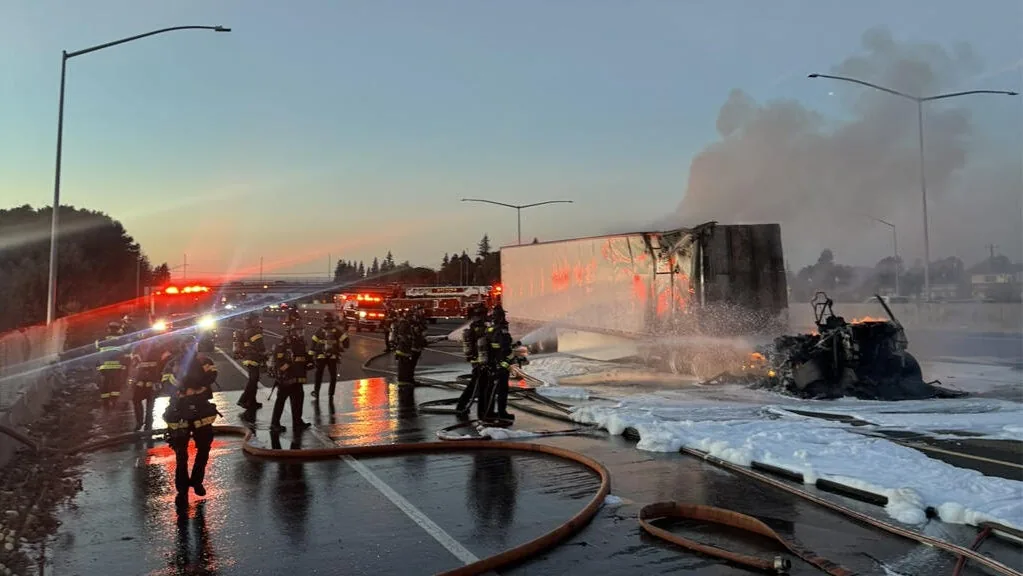
A Tesla Semi fire closed Interstate 880 in Hayward, California, on 27 October. The San Francisco Chronicle’s report, updated on 28 October and drawing on California Highway Patrol information, described a battery fire, no other vehicles involved and no injuries immediately reported. The cause remained under investigation. Battery involvement alone does not establish that a battery defect started the incident. [1]
The US National Fire Protection Association estimates an annual average of 15,462 large-truck-related fires in 2018–2022, or about 15,500 a year. The total covers all fuels and includes 8,350 semi-trailer fires. It is broader than a count of powered tractor units. [2]
Mechanical failure or malfunction was recorded as a contributing factor in 6,814 fires, or 44%. Electrical failure or malfunction was listed for 1,156, or 7%. Collision and related factors were recorded in 272, or 2%, while 4,452, or 29%, had no factor reported. Multiple factors can be recorded, so the percentages need not add to 100%. [2]
“Electrical failure” is not a synonym for traction-battery failure. Equally, a fire without a recorded collision factor has not automatically been proved spontaneous. The figures describe estimated reported incidents; they do not identify a cause for the Hayward fire.
For a diesel-versus-electric comparison, the missing denominator matters. NFPA’s large-truck tables do not split the fire total by propulsion and provide matching fuel-specific fleet sizes or mileage. The 15,500 figure therefore cannot be labelled diesel fires, or divided by unrelated registration figures to produce a reliable risk ratio.
Electric-truck research has recognised the problem. A 2023 RISE review for Volvo Trucks describes scarce electric-truck fire data and samples too small for firm statistical conclusions. Some of the truck records it discusses include lighter, experimental or modified vehicles. The review does not provide a current, matched comparison between production electric articulated lorries and diesel equivalents. [3]
A useful comparison would need the same vehicle class, period and territory on both sides. Researchers would also need consistent treatment of trailers, deliberate fires and collisions, alongside the number of trucks in service or miles driven. Fleet age and duty cycle would need consideration. Counting widely shared electric-truck videos against a conventional-truck total, or borrowing passenger-car figures, does not meet those requirements.
Fire frequency is also separate from the consequences of an individual fire. UK government recovery guidance warns that thermal runaway can generate substantial fire and vapour hazards. That supports planning for the behaviour of a damaged high-voltage battery, rather than treating a low or unknown incident rate as a reason to ignore it. [4]
Current research also separates the original ignition from later battery involvement. The National Transport Research Organisation’s October 2026 electric-truck safety project discusses delayed ignition and reignition when batteries are involved. Its practical toolkit adds response guidance, but no comparable diesel-versus-electric heavy-truck fire rate. The question of how a fire develops therefore needs its own evidence alongside how often fires happen. [5]
The available figures show that truck fires are an established industry problem across a broad vehicle category. They do not support a numerical claim that an electric articulated lorry is more or less likely to burn than a diesel one. For Hayward, the initiating cause remains the immediate unanswered question. A completed investigation and comparable fleet data would answer different parts of the safety debate.
Sources
The links below support the statements attributed to them. A source’s own claims are identified in the article.
- San Francisco Chronicle’s Hayward reportSan Francisco Chronicle · Contemporaneous local reporting quoting CHP
- NFPA vehicle-fire tablesNational Fire Protection Association · Primary statistical analysis of NFIRS and NFPA fire-department survey data
- RISE electric-truck fire reviewRISE Research Institutes of Sweden · Research review prepared for Volvo Trucks
- UK electric-vehicle recovery guidanceUK government · UK government primary operational guidance
- NTRO electric-truck safety projectNational Transport Research Organisation · Research-project owner announcement